

How to Help Aging Parents Move Without the Stress
Key Takeaways
- Nearly 90% of seniors want to age in place, making the decision to move emotionally complex
- Listening without rushing to solutions is the most important thing you can do for your parent
- Relocation Stress Syndrome is a real medical condition that can affect seniors during moves
- Involving your parent in decisions leads to better outcomes than making choices for them
- Professional help from companies like Downsize & Thrive can reduce family conflict and physical burden
You stand in your parents’ living room and see forty years of life packed into every closet, drawer, and corner.
The move needs to happen. Your parents’ health demands it, or the house has become too much to manage. But where do you even start?
You’re not alone in this. Family caregivers increased by 32% between 2011 and 2022, and many of them face exactly what you’re facing right now. At Downsize & Thrive, we’ve walked many families through this transition. Here’s what actually works when you need to help aging parents move.
Start with Listening, Not Planning
Helping aging parents move works best when you start with listening, divide the process into 6-8 week stages, and involve your parent in every decision.
Your first instinct is probably to make a plan and start executing.
Resist that urge. Clinical psychologist Erlene Rosowsky found that listening is the most important thing an adult child can do for an older parent. You haven’t experienced aging yourself, so you can’t fully understand what your parent is going through.
What this looks like in practice
- Ask your parent to tell you stories about their home and belongings
- Listen without immediately offering solutions
- Acknowledge that this transition is hard without minimizing their feelings
- Give them space to process emotions at their own pace
Research shows that when you ask older adults to share stories, it changes the dynamic. Your parent becomes an equal participant in the conversation instead of someone being managed.
Understand What Your Parent Is Actually Losing
This isn’t just about moving furniture from Point A to Point B.
Nearly two in three seniors say they have an emotional attachment to their home. Your parent isn’t leaving a house. They’re leaving decades of memories, independence, and identity.
Relocation Stress Syndrome is real. It’s an officially recognized nursing diagnosis characterized by anxiety, confusion, hopelessness, and loneliness that usually occurs in older adults shortly after moving from a private residence to a nursing home or assisted-living facility. Symptoms often appear within the first month and can lead to serious health issues.
You need to make space for grief while still moving forward with practical steps.
Involve Your Parent in Every Decision When Moving
Seniors who participate in decisions about where they’ll live experience better outcomes than those who have choices made for them. This means your parent gets final say on what stays and what goes, even if you disagree with some choices.
Decision-making framework that works:
- Measure the new space together so your parent knows what will fit
- Let them choose which furniture and belongings to move
- Ask which items hold the most meaning rather than assuming you know
- Respect their timeline when possible, even if it feels slower than you’d like
As long as a parent is competent to make decisions, your job is to support, not control.
Break the Process into Manageable Steps
The full scope of a move overwhelms everyone. You’re looking at sorting thousands of items, coordinating multiple vendors, and managing logistics while your parent processes emotions.
Start small.
Move Prep and Execution Timeline:
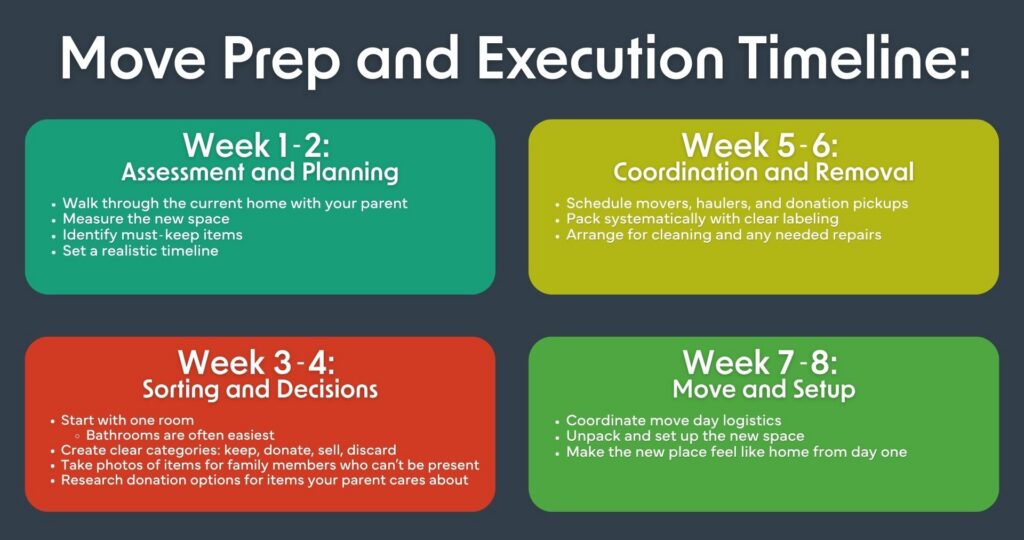
Week 1-2: Assessment and Planning
- Walk through the current home with your parent
- Measure the new space
- Identify must-keep items
- Set a realistic timeline
Week 3-4: Sorting and Decisions
- Start with one room (bathrooms are often easiest)
- Create clear categories: keep, donate, sell, discard
- Take photos of items for family members who can’t be present
- Research donation options for items your parent cares about
Week 5-6: Coordination and Removal
- Schedule movers, haulers, and donation pickups
- Pack systematically with clear labeling
- Arrange for cleaning and any needed repairs
Week 7-8: Move and Setup
- Coordinate move day logistics
- Unpack and set up the new space
- Make the new place feel like home from day one
Know When to Bring in Professional Help
You don’t have to manage this alone.
Most families underestimate the physical and emotional toll of helping aging parents move. The average caregiving period lasts about 4 years, but 15% of caregivers provide care for at least a decade. That’s a marathon, not a sprint.
Professional help makes sense when:
- You live out of town and can’t be physically present for weeks
- The volume of belongings exceeds what your family can handle
- Family members disagree about how to proceed
- Your parent needs someone neutral to guide decisions
- You’re juggling full-time work and can’t take extended time off
- The timeline is tight due to health needs or property deadlines
A move management company handles the coordination you’d otherwise manage yourself. They sort, pack, coordinate vendors, and set up the new space so your parent walks into a home that’s already functional.
Protect Your Parents’ Dignity Throughout The Move
Your parent is making a wise decision to move, even if circumstances are forcing their hand. Treat them as a capable adult who’s navigating a difficult transition, not as someone who needs to be managed.
This means:
- Never rushing them through emotional moments
- Asking permission before discarding or donating items
- Respecting their pace, even when you’re anxious to finish
- Acknowledging what they’re giving up, not just what they’re gaining
- Celebrating the move as a new chapter, not an ending
Research in nursing homes found that when staff asked residents to share stories about their lives, it fundamentally changed the relationship. Your parent has wisdom and experience. Let them contribute that to the process.
Plan for the Emotional Timeline
The legal timeline and the emotional timeline rarely align.
You might have 90 days to clear the house for probate or sale. Your parent might need 90 days just to process what’s happening.
Build in buffer time for emotional processing. Schedule sorting sessions with breaks. Don’t pack every weekend for two months straight and expect your parent to keep up emotionally.
Signs your parent needs more time:
- They’re withdrawing from the process
- Every sorting session ends in tears or conflict
- They’re making decisions they later regret
- Physical symptoms like headaches or fatigue increase
If you’re hitting these walls, slow down. Bring in outside help. Adjust the timeline if possible.
Handle Family Dynamics Before They Explode
Siblings who won’t help. Family members who disagree about what to keep. Out-of-town relatives who second-guess every decision.
These dynamics can destroy relationships if you don’t address them early.
Set clear expectations upfront:
- Who will be physically present for sorting and packing?
- How will decisions get made when family members disagree?
- What’s the communication plan for updates?
- How will costs be divided?
Put one person in charge of coordination. Too many decision-makers creates chaos. Other family members can contribute in specific ways without needing to approve every choice.
A neutral third party, like a move manager, can absorb family conflict and keep the project moving forward.
Check for Hidden Value

Buried in most homes are items worth more than families realize.
Vintage tools, mid-century furniture, first-edition books, and costume jewelry that isn’t costume at all. These items end up in dumpsters because families don’t know what they have.
Before you haul anything away:
- Research current values for items that seem old or unusual
- Take photos and post in collector groups for identification
- Get appraisals for jewelry, art, or antiques
- Consider consignment for quality furniture
The money recovered from selling valuable items can offset moving costs significantly.
Make the New Space Feel Like Home Immediately
Your parent or parents shouldn’t spend their first night in the new place surrounded by boxes.
Set up the bedroom completely before they arrive. Make the bed with their familiar bedding. Hang photos. Stock the bathroom. Organize the kitchen so they can make coffee the next morning.
This isn’t about perfection. It’s about creating immediate comfort in an unfamiliar space.
Priority setup areas:
- Bedroom (bed made, clothes in closet, familiar items visible)
- Bathroom (toiletries accessible, towels hung)
- Kitchen (coffee maker set up, basic supplies stocked)
- Living area (favorite chair positioned, TV connected, photos displayed)
The goal is for your parent to walk in and recognize their life in the new space.
Frequently Asked Questions
How long does it take to help an aging parent move?
A typical move takes 6-8 weeks from initial planning to final setup, though this varies based on the home’s size and your parents’ pace. Rushing the timeline often backfires emotionally.
What if my parent refuses to move?
As long as they’re competent to make decisions, they have the right to refuse. Focus on listening to their concerns and addressing specific fears rather than pushing the move itself.
How do I handle siblings who won’t help?
Set clear expectations early about who will contribute what. Accept that some family members will opt out entirely. Focus your energy on the people who show up.
Should I hire professional movers or do it ourselves?
Professional help makes sense when the volume exceeds what your family can handle, when you live far away, or when you need to maintain your job and other responsibilities during the transition.
How much does it cost to move an aging parent?
Costs vary widely based on distance, home size, and services needed. Budget for moving, packing, hauling, cleaning, and potential storage. Professional move management typically costs less than families expect when you factor in time saved and stress reduced.
You And Your Parent Don’t Have to Do This Alone
Helping aging parents move is one of the hardest transitions you’ll navigate as an adult child. The physical work is manageable; it’s the emotional weight that overwhelms families.
At Downsize & Thrive, we handle the entire process so you can focus on being present with your parent. We sort, pack, coordinate vendors, and set up the new space at your parents’ pace, treating their belongings with the respect they deserve.
Call us at (216) 905-3669 or contact us online for a free consultation. We’ll give you a clear plan and take the operational burden off your shoulders, so this transition feels manageable rather than overwhelming.