

How to Talk to Your Parents About Downsizing (Without It Turning Into a Fight)
The best way to talk to your parents about downsizing is to start early, before a health scare or a crisis forces the decision, and to open with a question instead of a plan. Ask how they feel about their home and their day-to-day life right now. Listen before you offer solutions. This is rarely a single conversation. It’s usually several smaller ones, spread over weeks or months, that slowly build trust.
If you’ve already tried once and it went nowhere, that doesn’t mean you failed. It means the conversation isn’t over yet. Here’s how to approach it in a way that protects your relationship with your parent and still moves things forward.
Key Takeaways
- Start the downsizing conversation months before you think you’ll need to, not during a health crisis.
- Open with a question about how your parent feels about their home, not a plan for what should happen to it.
- Frame downsizing as your parent’s decision, not a change you’re asking them to accept.
- Expect more than one conversation. Most families need several smaller talks before a parent feels ready.
- If the conversation keeps stalling, a neutral third party, like a downsizing professional, can take on logistics so you can stay focused on the relationship.
- Avoid any language that implies your parent should have acted sooner. That framing shuts the conversation down fast.
Why This Conversation Feels So Hard for Everyone
For your parent, downsizing can feel like losing independence, not gaining simplicity. Their home holds decades of memories, routines, and identity. Even a gentle suggestion to move can land as a message that they can no longer be trusted to manage their own life.
For you, the urgency usually comes from a different place. Maybe you noticed something blocking a hallway, or you’re worried about stairs, or you live far away and can’t check in as often as you’d like. That worry is real. But if it comes out as pressure, your parent will hear “you’re not capable anymore,” even if that’s not what you meant.
Both of you are trying to protect something. Your parent is protecting their independence. You’re protecting their safety and your own peace of mind. Naming that tension, even just to yourself, makes the actual conversation easier to have with patience instead of urgency.
How to Open the Conversation Without Triggering Defensiveness
Timing matters as much as wording. Bring it up during a calm, unhurried moment, not right after a fall, a diagnosis, or a family disagreement. Once emotions are already high, almost anything you say will land as an attack.
Lead with curiosity, not a proposal. Instead of announcing a plan, ask a question and actually wait for the answer.
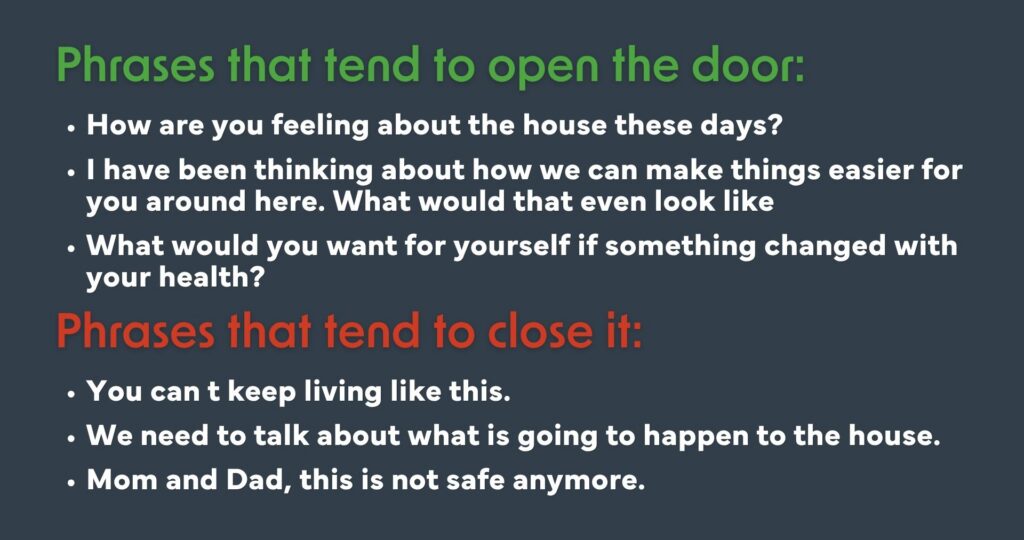
The difference isn’t just tone. The first set treats your parent as the decision maker. The second set treats them as a problem to be managed. Even loving intentions can land wrong if the words put your parent on the defensive from the first sentence.
What to Say When Your Parent Pushes Back
Pushback is normal, and it’s not a sign that the conversation failed. Most people resist a big life change on the first pass, especially one this personal.
If your parent deflects or shuts the topic down, resist the urge to make your case harder. Instead, try acknowledging what you heard: “It sounds like this feels like a big change right now. I hear that.” Then let the topic rest.
If your parent raises a specific worry, like leaving a neighborhood they love or losing space for grandchildren to visit, treat it as real information, not an obstacle to argue past. These concerns are often solvable once you understand exactly what your parent is afraid of losing. For ideas on handling sentimental belongings with care once the conversation does move forward, see our guide to compassionate downsizing tips for seniors.
What doesn’t help: repeating your point louder, bringing in other family members to gang up on the conversation, or setting an ultimatum. Pressure tends to make people dig in, even when part of them agrees with you.
Why One Conversation Is Rarely Enough
Give the idea time to settle. Many families revisit this topic three, four, or more times before a parent is ready to take any action. That’s not a stall tactic on your parent’s part. It’s how people process a change this significant.
Between conversations, look for small, low-stakes ways to keep the door open: mentioning a friend’s positive experience with a move, sending an article, or simply asking “any new thoughts about the house?” during an unrelated call. If your family already has a sense of how to know when it’s time to downsize, it can help to revisit those signs together instead of relying on your judgment alone.
Patience here isn’t passive. It’s the strategy. Adult children who push for a decision in one sitting often set the whole process back further than those willing to let it unfold over months.
When to Bring In a Neutral Third Party
If you’ve had this conversation multiple times, with patience and without pressure, and it’s still stuck, that’s a reasonable point to bring in outside help. This isn’t giving up. It’s recognizing that some of the resistance may be about you, specifically, being the one raising it, not about the idea itself.
A neutral third party can absorb the parts of this process that feel most personal between you and your parent. According to the National Institute on Aging, professionals like geriatric care managers can be especially helpful when family members live far apart or when logistics have become the main sticking point. The same holds true for downsizing professionals: they can walk through the home, answer practical questions, and let your parent ask things they might not want to ask you directly.
This also gives your parent someone new to talk to who isn’t attached to the outcome the way you are. Many parents open up differently to a professional than they do to their own children, simply because there’s less emotional history in the room.
Frequently Asked Questions
How do I start the conversation about downsizing with my parents?
Start with a question, not a plan. Ask how they feel about their home and their day-to-day routine right now, during a calm moment with no other stress in the room. Listen fully before offering any suggestions. Starting with curiosity instead of a proposal makes your parent far less likely to feel cornered or managed.
What if my parents refuse to downsize?
Refusal on the first attempt is common and doesn’t mean the conversation is over. Acknowledge their feelings, let the topic rest, and revisit it gently in the weeks ahead. Most families need several conversations before a parent feels ready. Pushing harder after a refusal usually causes more resistance, not less.
How many times should I bring up downsizing before getting outside help?
There’s no fixed number, but if you’ve raised it calmly several times over a few months with no movement, it’s reasonable to bring in a neutral third party. A downsizing professional can address the same practical questions without the emotional history that sometimes makes progress harder between parent and child.
Is it normal for this conversation to take months?
Yes. Deciding to leave a home of decades is one of the biggest emotional decisions a person can make. Most families move through this gradually, with several smaller conversations rather than one turning point. Expecting a quick resolution usually creates pressure that slows things down instead of speeding them up.
Where This Conversation Leads
The goal of this conversation isn’t to win an argument or reach a decision by a certain date. It’s to help your parent feel heard while keeping the door open for a plan that works for them, on their timeline.
When your parent is ready to think through what downsizing would actually look like, our team at Downsize & Thrive can walk through the details with them directly and without judgment. We’re used to this conversation, and we know how to have it gently. Reach out anytime at 216-218-9475 or contact us online when the time feels right.